
Introduction: The Eternal Allure of the Yellow Metal of Gold Jewellers
Since the dawn of human civilization, Gold Jewellers few substances have captivated the human imagination, driven the course of history, or symbolized wealth and divine favor quite like gold. This indestructible, radiant yellow metal, forged in the heart of dying stars and scattered across the Earth’s crust, has been the bedrock of empires, the standard of economies, and the ultimate expression of personal adornment. In the vibrant and deeply rooted cultures of South Asia, gold transcends its elemental properties. It is not merely a commodity traded on stock exchanges or a shiny accessory; it is a profound cultural artifact, a cornerstone of familial security, and a canvas upon which centuries of artistic heritage are meticulously inscribed.
At the intersection of this immense cultural weight and breathtaking artistry stand the traditional jewelers—the guardians of an ancient craft. Among these venerable institutions is Chacha Nawaz Gold Jewellery, a name that resonates not just as a retail establishment, but as an archetype of trust, craftsmanship, and generational continuity. To understand the story of such an establishment is to understand the soul of traditional gold smithing. It is a world where fire and hammer meet delicate aesthetics, where the clinking of scales is accompanied by the sharing of familial milestones, and where every polished surface reflects a story of heritage.
This comprehensive exploration delves into the intricate world of traditional gold jewelers, using the ethos of Chacha Nawaz Gold Jewellery to unravel the complexities of the craft, the cultural significance of the ornaments, the economic intricacies of the trade, and the enduring legacy of artisanal mastery in a rapidly modernizing world.
Chapter 1: The Cultural Fabric of Gold Adornment
To comprehend the significance of a traditional jeweler, one must first understand the sociological and psychological role of gold in the region. Gold is inextricably linked to the rhythm of life, particularly the institution of marriage.
The Bridal Trousseau and the Concept of Stridhan
In the traditional context, a woman’s gold jewelry is often considered her Stridhan—wealth that belongs exclusively to her. Historically, in patriarchal societies where property rights for women were limited or complex, gold served as the ultimate financial safety net. It is a highly liquid asset, immune to the rot of time and easily transportable. When a family visits Chacha Nawaz Gold Jewellery to prepare for a wedding, they are not merely shopping for accessories; they are curating a financial portfolio for the bride.
The bridal set is the pièce de résistance of the trousseau. The process of selecting this jewelry is a deeply communal and ritualistic affair. Mothers, grandmothers, and aunts gather, scrutinizing designs, weighing the gold, and negotiating the making charges. The jewelry must be heavy enough to signify the family’s status, yet intricate enough to showcase their refined taste.
A Symbol of Status and Continuity
Beyond financial security, gold is the ultimate barometer of social standing. The sheer volume and intricate design of the gold worn at festive occasions serve as a silent language communicating prosperity. Furthermore, gold jewelry is meant to be inherited. A heavy bridal necklace bought from a trusted jeweler is rarely meant for one lifetime. It is preserved, cherished, and eventually passed down to the next generation, often redesigned or polished to suit the era, but always retaining the ancestral essence. Chacha Nawaz Gold Jewellery, in this sense, acts as a custodian of these family histories, repairing the clasps of antique necklaces and polishing rings that have seen decades of wear.
Chapter 2: The Ethos of Chacha Nawaz Gold Jewellery
The story of Chacha Nawaz Gold Jewellery is emblematic of the classic, self-made artisanal enterprise. The title “Chacha” (an affectionate term for paternal uncle) immediately establishes a dynamic of familiarity, respect, and familial bond. It breaks the sterile barrier between merchant and consumer, replacing it with a relationship based on profound trust.
The Genesis of a Master Craftsman
The origins of such an establishment typically trace back to a humble workbench. The eponymous founder, Chacha Nawaz, would have begun his journey not as a wealthy merchant, but as an apprentice—a shagird—to a master artisan. In this grueling apprenticeship, which often spans over a decade, the young artisan learns the alchemy of gold. He learns how to coax the stubborn metal into delicate wires, how to judge purity by the color of the flame, and how to embed precious stones without fracturing them.
The transition from artisan to shop owner is a monumental leap. It requires not just the skill of the hands, but an acute business acumen and, most importantly, an unblemished reputation. In the gold trade, reputation is the primary currency. Chacha Nawaz Gold Jewellery would have been built on a foundation of absolute transparency regarding the purity of the metal and the exactness of the weight.
The Philosophy of the Trade
For jewelers of this caliber, the business is governed by an unwritten code of ethics. The primary tenet is the sanctity of the karat. If a piece is sold as 22-karat gold, it must withstand any metallurgical test. Chacha Nawaz’s philosophy revolves around the idea that a customer cheated once is a family lost forever, whereas a customer treated fairly brings generations of patronage. This philosophy is reflected in the patient manner in which designs are discussed, the willingness to customize pieces to exact specifications, and the transparent weighing processes that occur in full view of the buyer.
Chapter 3: The Anatomy of Craftsmanship – From Dust to Dazzle
The transformation of raw gold into a breathtaking piece of jewelry is a complex, multi-stage process that requires the combined efforts of highly specialized artisans, known locally as karigars. The workshop of Chacha Nawaz Gold Jewellery is a symphony of controlled chaos, where intense heat, chemical baths, and microscopic precision coexist.
The Melting and Alloying Process
Pure 24-karat gold is too soft for intricate jewelry; it would easily bend and lose its shape. Therefore, the first step is alloying. The pure gold is melted in a crucible using a high-intensity blowtorch. During this liquid state, precise amounts of copper, silver, or zinc are added to create the desired purity—usually 22K or 21K for traditional jewelry. This alloying process not only hardens the metal but also imparts a specific hue. A higher copper content results in a reddish tint, while silver lends a cooler, greenish-yellow shade.
Tarkashi and Sheet Making
Once the alloy is cast into ingots, it is subjected to the physically demanding process of rolling and wire drawing. To create flat surfaces for pendants or bangles, the ingot is passed repeatedly through heavy steel rollers until it reaches the thinness of paper. For intricate filigree work, the gold is pulled through a drawplate—a steel plate with progressively smaller holes. The artisan uses massive tongs to pull the gold wire, a process known as Tarkashi, until the wire is as thin as a human hair.
The Art of the Karigar
The actual shaping of the jewelry is where the true artistry lies. The karigar sits at a low wooden bench, utilizing a mesmerizing array of tiny hammers, chisels, pliers, and files.
- Die Stamping (Thappa): For repetitive motifs, thin gold sheets are hammered into iron dies (thappas) to take on specific shapes, such as petals or leaves.
- Soldering: These individual components are then meticulously arranged on a heat-resistant surface and fused together using gold solder and a precise, breath-controlled blowpipe.
- Engraving (Chitrai): Once the basic structure is formed, specialized engravers use sharp chisels to carve microscopic patterns onto the gold surface, adding texture and catching the light.
Finishing and Polishing
The newly constructed piece is dull and covered in oxidation from the soldering process. It is first boiled in a mild acid solution to remove impurities. Then comes the final polishing, achieved through buffing wheels and traditional polishing agents, which brings out the brilliant, blinding luster that characterizes fine gold jewelry.
Chapter 4: The Lexicon of Design: Ornaments of Heritage
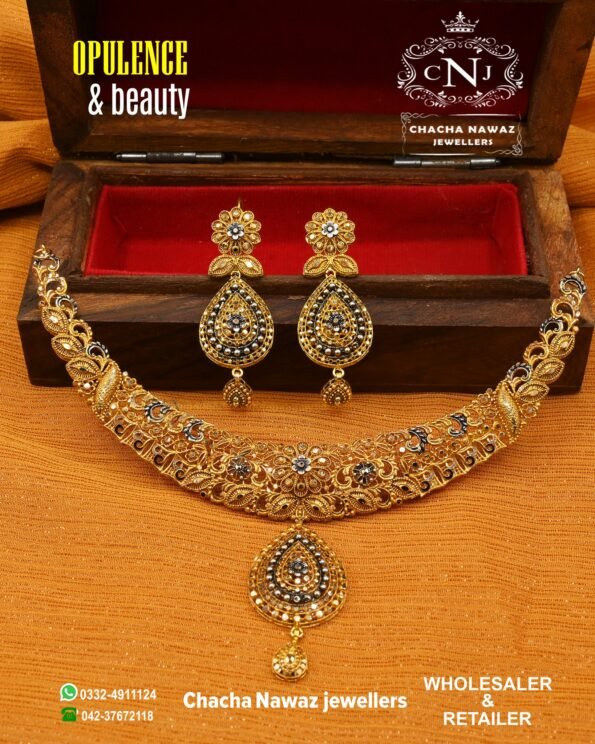
The showcases at Chacha Nawaz Gold Jewellery are not merely displays of wealth; they are museum-quality exhibitions of regional history and design evolution. Traditional jewelry is highly specific, with distinct ornaments designed for virtually every part of the body.
Adorning the Head and Face
- Matha Patti and Tikka: The Tikka is a pendant that rests on the center of the forehead, suspended by a chain hidden in the hair parting. The Matha Patti extends this concept, with jeweled bands bordering the hairline, framing the bride’s face in gold and gemstones.
- The Nath (Nose Ring): Perhaps the most culturally potent piece of bridal jewelry, the Nath is a large hoop, often embellished with pearls and rubies, supported by a delicate gold chain pinned to the hair. It is deeply symbolic of a woman’s marital status.
- Jhumkas and Balis: Traditional earrings are heavy and elaborate. Jhumkas feature a distinct bell-shaped dome that dangles and catches the light with every movement. Balis are large crescent-shaped hoops, often featuring intricate wirework.
Encircling the Neck
- The Choker (Gulband): A tight-fitting necklace that sits high on the neck, usually crafted with highly detailed metalwork and tightly set stones.
- The Rani Haar: Translating to “The Queen’s Necklace,” this is a long, majestic piece that cascades down to the chest. It often features multiple strands of gold beads or pearls, culminating in a massive, ornate pendant. The combination of a Gulband and a Rani Haar is the quintessential bridal look.
Embellishing the Arms and Hands
- Bangles (Chooriyan) and Kangan: Gold bangles are worn in sets, producing a distinctive, melodic clinking sound. Kangans are heavier, thicker bangles, often featuring animal head terminals (like elephants or peacocks) or intricate enamel work.
- The Haath Phool: Literally translating to “Hand Flower,” this spectacular ornament consists of rings worn on the fingers, connected by radiating gold chains to a central medallion on the back of the hand, which is in turn connected to a bracelet.
Each of these pieces crafted by the artisans at Chacha Nawaz Gold Jewellery is a study in proportion, balance, and the physics of the human body, designed to sit gracefully and move fluidly with the wearer.
Chapter 5: The Intricate Arts: Kundan, Polki, and Meenakari
While solid gold jewelry is breathtaking in its own right, the true zenith of traditional craftsmanship is achieved when gold is combined with gemstones and color. Establishments like Chacha Nawaz Gold Jewellery are often renowned for their mastery over these highly specialized, centuries-old techniques.
The Grandeur of Kundan and Polki
Kundan is perhaps the oldest form of jewelry making in the subcontinent, tracing its roots back to the royal courts of the Mughal Empire. It involves setting precious or semi-precious stones with highly refined, 24-karat pure gold foil. The process begins with a skeletal framework called the Ghaat. Once the framework is ready, lac (a natural resin) is poured into the hollow spaces. The stones—often Polki (uncut, unpolished diamonds that emit a soft, celestial glow)—are pressed into the lac. The defining step of Kundan is the setting. The artisan uses ribbons of extremely pure, soft gold foil, pressing them around the edges of the stone using a specialized iron tool. The gold bonds to itself at room temperature through pressure, creating a seamless, highly secure bezel that holds the stone securely without the use of prongs. The resulting aesthetic is regal, heavy, and dripping with antiquity.
The Magic of Meenakari (Enameling)
Often, the reverse side of a Kundan piece is just as beautiful as the front. This is due to Meenakari, the art of enameling. To prevent the heavy gold jewelry from irritating the skin, and to add a secret, intimate beauty known only to the wearer, the backs of necklaces and pendants are decorated with vivid colors. The gold surface is carefully engraved with delicate motifs, usually birds, flowers, or vines. Crushed glass of various colors—cobalt blue, ruby red, emerald green—is mixed with a binding agent and painted into these microscopic grooves. The piece is then fired in a small kiln. The heat melts the glass, fusing it securely to the gold. Once cooled, the surface is polished, resulting in an exquisite, vibrant, and permanent burst of color that contrasts beautifully with the yellow metal. The artisans employed by Chacha Nawaz for Meenakari possess a painter’s eye and a metallurgist’s understanding of heat.
Chapter 6: The Economics of Trust – Purity, Scales, and Generational Bonds
The relationship between a customer and a traditional jeweler like Chacha Nawaz is deeply rooted in micro-economics, traditional metrics, and implicit trust. Buying gold is a complex transaction involving fluctuating global markets and ancient local customs.
The Language of Purity: Karats
Gold purity is measured in karats, with 24K representing 99.9% pure gold. However, as established, traditional jewelry is rarely made of 24K gold due to its malleability.
- 22 Karat (91.6% purity): This is the gold standard for South Asian bridal jewelry. It offers the perfect balance—it retains the rich, deep yellow color of pure gold while possessing enough structural integrity to hold intricate designs and withstand wear.
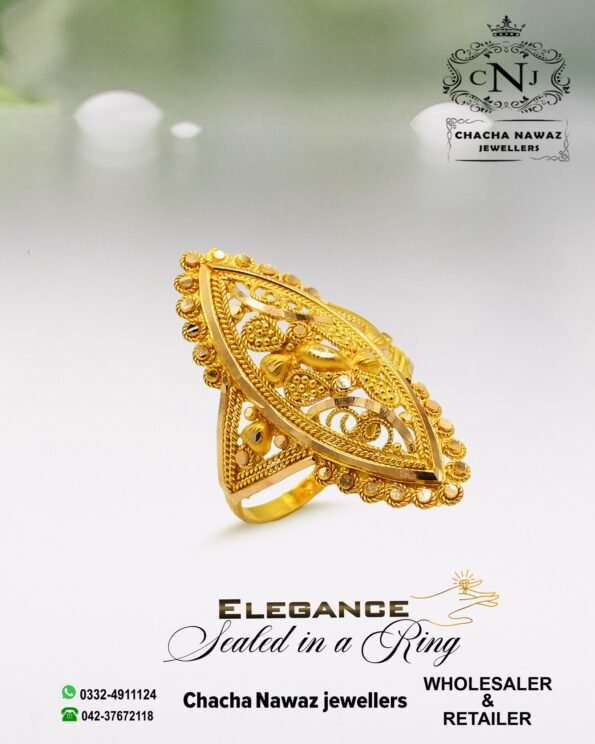
- 21 Karat (87.5% purity): Highly popular in many regions, 21K gold is slightly harder and often used for items that require more durability, such as daily-wear bangles or rings.
- 18 Karat (75.0% purity): Generally used for diamond-studded jewelry or highly modern, delicate pieces. The higher alloy content provides a rigid grip for stone settings.
The Traditional Weight System: Tola, Masha, and Ratti
While the modern world operates on grams and ounces, the traditional gold market relies heavily on a historical system of weights that dates back centuries. Customers entering Chacha Nawaz Gold Jewellery will invariably negotiate in terms of the Tola.
- 1 Tola is universally accepted in this market as equal to 11.6638 grams.
- A Tola is further divided into 12 Mashas.
- A Masha is divided into 8 Rattis. (Historically, a ratti was based on the weight of the Abrus precatorius seed, which was remarkably consistent in mass).
A seasoned jeweler and a savvy customer can perform complex mental mathematics, converting current global per-ounce gold prices into the local per-tola rate within seconds.
The Mathematics of the Purchase
A gold purchase at Chacha Nawaz involves three distinct financial components:
- The Gold Rate: This fluctuates daily, sometimes hourly, based on international markets, currency exchange rates, and local supply and demand.
- The Actual Weight: The piece is weighed on highly sensitive, government-calibrated digital scales (which have largely replaced the traditional balance scales, though the terminology remains).
- Making Charges (Mazdoori): This is the cost of the artisanship. Making charges vary wildly depending on the complexity of the piece. A simple gold chain might have a minimal making charge, while a handcrafted Kundan Rani Haar might carry a making charge of 15% to 25% of the total gold value. This is the area where negotiation occurs, and where the jeweler’s reputation for fairness is tested.
The Guarantee of Buyback
The ultimate testament to a jeweler’s integrity is their buyback policy. Chacha Nawaz Gold Jewellery thrives on the promise that any piece bought from their store can be sold back to them at the prevailing market rate of gold, minus a standard, pre-agreed deduction for melting loss. This guarantee transforms the jewelry from a mere accessory into a liquid financial asset. Families know that in times of crisis, the gold bought from Chacha Nawaz can immediately be converted into cash.
Chapter 7: Modernity vs. Tradition – Navigating the 21st Century
The turn of the 21st century brought unprecedented challenges and transformations to the traditional gold jewelry landscape. An establishment like Chacha Nawaz Gold Jewellery does not survive for decades by remaining static; it must evolve while fiercely guarding its core identity.
The Threat and Promise of Machine-Made Jewelry
The advent of 3D printing, CAD (Computer-Aided Design), and mass-production machinery has revolutionized jewelry manufacturing. Machine-made jewelry is lighter, offers incredible precision, and significantly reduces making charges. Factories can produce thousands of identical, flawless rings in the time it takes a single karigar to craft one. However, Chacha Nawaz recognizes that while machines can produce perfection, they cannot produce a soul. Machine-made jewelry often lacks the hefty feel, the unique, microscopic imperfections, and the artisanal warmth of handcrafted pieces. To adapt, wise jewelers incorporate modern technology for basic structural work or contemporary daily-wear lines, while proudly reserving the labor-intensive handcrafting for their high-end, bridal, and traditional collections.
Changing Consumer Demographics
The modern bride is different from her grandmother. She is often a working professional who may prefer minimalist, wearable designs over the heavy, ornate Rani Haars that spend most of their time locked in a safe. Furthermore, exposure to global fashion trends via social media means that customers are demanding fusions of Western silhouettes with Eastern craftsmanship. Chacha Nawaz Gold Jewellery responds to this by diversifying its portfolio. Alongside the traditional heavy sets, the showcases now feature lightweight 18K white gold pieces, delicate diamond pendants, and modular jewelry—a heavy necklace that can be dismantled to be worn as a simple pendant for less formal occasions.
Economic Volatility
The traditional jeweler also has to navigate immense economic pressures. Skyrocketing global gold prices can suddenly price out the middle-class consumer. During economic downturns, jewelers must be innovative, creating designs that look voluminous and heavy but are structurally hollow or utilize wirework (filigree) to reduce the actual weight of the gold without compromising the visual impact. This requires a heightened level of skill from the artisans, pushing the boundaries of metallurgical engineering.
Chapter 8: The Socio-Economic Impact of the Traditional Jeweller
It is crucial to recognize that an establishment like Chacha Nawaz Gold Jewellery is not an isolated commercial entity; it is the center of a vast socio-economic ecosystem.
Sustaining the Artisan Community
Behind the polished glass of the showroom lies a network of workshops that employ dozens, sometimes hundreds, of skilled workers. These karigars often belong to families that have been in the trade for generations. The jeweler provides them with a steady livelihood, preserving ancient techniques that might otherwise be lost to industrialization. By continuing to commission handcrafted Kundan, Meenakari, and Tarkashi work, Chacha Nawaz acts as a patron of the arts, ensuring that the hammer and chisel continue to sing in the backstreets of the city.
A Pillar of the Local Economy
The gold trade is a massive driver of the local economy. It supports ancillary businesses—from the refineries that purify the scrap gold, to the security firms that transport the bullion, to the specialized makers of the velvet boxes in which the jewelry is presented. Furthermore, during the wedding season, the influx of capital into the gold markets stimulates broader economic activity.
Philanthropy and Community Standing
In traditional market cultures, prominent jewelers often serve as community leaders. Their wealth and their reputation for honesty place them in positions of trust outside of their business. It is common for the owner of Chacha Nawaz Gold Jewellery to act as a mediator in local disputes, a major contributor to neighborhood charities, and a financier for the weddings of their less fortunate employees. The shop becomes an institution that anchors the social fabric of the marketplace.
Chapter 9: The Psychology of the Gold Purchase
The act of buying gold from a traditional jeweler is an immersive, multi-sensory, and highly psychological experience. It is vastly different from the sterile, transactional nature of modern retail.
The Architecture of Hospitality
When a family steps into Chacha Nawaz Gold Jewellery, they are not treated merely as shoppers; they are treated as honored guests. The showroom is often designed to induce a sense of calm and opulence. Bright, warm lighting is specifically calibrated to make the yellow metal gleam. The seating is comfortable, often involving plush sofas rather than stiff chairs, encouraging families to spend hours deliberating. Hospitality is paramount. The offering of cold beverages in the summer, or warm, cardamom-infused tea in the winter, is a mandatory ritual. This hospitality serves a dual purpose: it honors the customer, and it relaxes them, creating an environment conducive to making significant financial decisions.
The Dance of Negotiation
The negotiation over the making charges (mazdoori) is a cultural dance. It is expected and respected. The customer will feign shock at the quoted price; the jeweler will passionately defend the intricate labor of his artisans. This back-and-forth is rarely hostile. It is a process of finding mutual respect. When a final price is agreed upon, it is sealed with a handshake and a sense of shared satisfaction. The jeweler has made a fair profit, and the family feels they have secured a valuable asset for their daughter’s future.
The Unboxing and the Final Weighing
The climax of the purchase is the final weighing. The jeweler will dramatically place the finished, polished piece on the digital scale in full view of the family. The red LED numbers confirm that the weight promised is the weight delivered. The piece is then carefully placed in a velvet or silk-lined box. This moment is highly emotional; it represents the culmination of years of saving by the parents and marks a tangible step toward the wedding day.
Chapter 10: The Preservation of Knowledge and the Future of the Craft
As the original “Chacha Nawaz” ages, the critical question of succession arises. The survival of traditional gold jewelry depends entirely on the successful transfer of both technical knowledge and business ethics to the next generation.
The Burden of the Heir
The sons or daughters who take over the establishment inherit a heavy mantle. They must possess the traditional knowledge to assess gold and evaluate craftsmanship, but they must also possess modern skills: digital marketing, global supply chain management, and an understanding of contemporary design software. The successful transition of Chacha Nawaz Gold Jewellery to the second or third generation often involves a modernization of the backend operations while fiercely protecting the traditional frontend experience. Inventory might now be tracked via complex software rather than handwritten ledgers, and marketing might happen via high-fashion Instagram shoots rather than word-of-mouth, but the tea is still served hot, and the gold is still weighed in front of the customer.
The Educational Void
One of the greatest challenges facing the industry is the lack of formal educational institutions for traditional gold smithing. The master-apprentice model, while historically effective, is struggling to attract modern youth who often seek less physically demanding, white-collar professions. To counter this, forward-thinking jewelers are having to incentivize the craft, offering better working conditions, health benefits, and higher wages to ensure that the secrets of Kundan and Meenakari do not die out with the current generation of elderly artisans.
Conclusion: The Eternal Shine of Master Craftsmanship
In an era characterized by planned obsolescence, fast fashion, and fleeting digital trends, the world of traditional gold jewelers stands as a monument to permanence. Chacha Nawaz Gold Jewellery is not just a commercial enterprise that deals in a precious metal; it is an institution that deals in legacy, security, and art.
The gold that passes through the hands of its artisans is older than the Earth itself, born in the cosmic fires of the universe. Yet, it is in the quiet, focused intensity of the workshop that this cold metal is given a soul. It is transformed into a Nath that will make a bride weep with joy, a Rani Haar that will be worn by a mother with immense pride, and a pair of bangles that will one day be passed down to a granddaughter as a tangible piece of her family’s history.
To patronize a traditional jeweler is to participate in an ancient, beautiful ritual. It is a rejection of the mass-produced in favor of the meticulously handcrafted. It is a profound statement of trust in the integrity of a master craftsman. As long as there are families who wish to celebrate their milestones, as long as there is an appreciation for the breathtaking artistry of the karigar, and as long as there is a human desire to hold something beautiful, permanent, and inherently valuable, the legacy of establishments like Chacha Nawaz Gold Jewellery will continue to shine, undiminished by the passage of time. The fire in the crucible will burn on, and the delicate tap of the artisan’s hammer will continue to echo, forging links of gold that bind the past, the present, and the future.


